


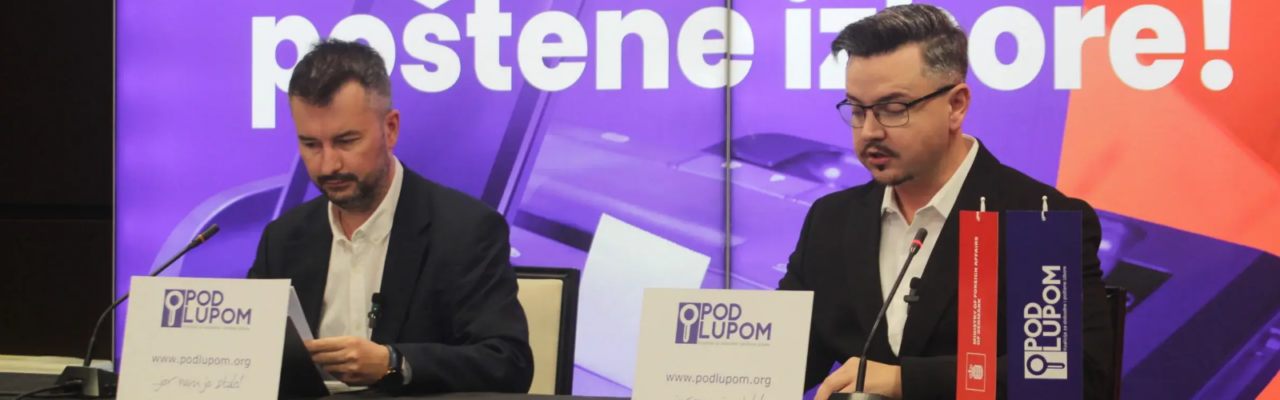
The Coalition for Free and Fair Elections “Pod lupom” presented the results of its latest public opinion survey on citizens’ trust in elections in Bosnia and Herzegovina and how they access information.
Public trust in the electoral process in Bosnia and Herzegovina remains extremely low. As many as 73.9% of citizens believe that elections in BiH are not free and fair, indicating deeply rooted distrust in the electoral process and a widespread perception that irregularities can affect the actual will of voters.
Citizens’ experiences further confirm this perception. A total of 11.2% of respondents stated that they had witnessed vote-buying or another form of electoral fraud.
Distrust in the electoral process is also accompanied by low levels of trust in political actors and officials. Currently, the Central Election Commission of BiH enjoys the highest level of public trust (21.54%), followed by the “Pod lupom” Coalition (20.73%), candidates (18.33%), Municipal/City Election Commissions (OIK/GIK) (16.95%), political parties (9.28%), government and public officials (5.04%), other NGOs (4.12%), and the media (4.01%). Interestingly, ahead of the 2024 Local Elections, citizens placed the highest level of trust in candidates (20.3%).
On the other hand, although the media are the actors citizens trust the least, they remain their primary source of information, with as many as 63.5% of respondents relying on them. Television remains the main source of information (47.9%). However, despite being the primary source of information, 69.9% of citizens say they do not trust the information they receive through the media, 75.5% believe that the media do not report objectively during election campaigns, and 78.95% say they have noticed certain political parties or politicians being favoured in media coverage.
Citizens’ distrust is further linked to the perception that existing accountability mechanisms cannot be used effectively enough to deter electoral irregularities. As many as 77.4% of citizens believe that the existing sanctions are not sufficiently severe to have a deterrent effect.
One particularly positive finding is that the majority of citizens (80.4%) express strong support for the introduction of new election technologies as a measure to prevent electoral irregularities, while 60.9% believe that the introduction of these technologies will help protect their vote.
Furthermore, despite all the challenges and the high level of distrust, 73.5% of citizens in BiH say they will vote in the 2026 General Elections. This finding indicates that, although concerned about irregularities, citizens are encouraged by the introduction of new election technologies and continue to see elections as an opportunity to decide who will represent their interests.
The public opinion survey was conducted within the “Civil Society for Election Integrity” project, funded by the European Union and co-funded by the French Embassy and Sweden.
In order to ensure compliance with the provisions of the Election Law of Bosnia and Herzegovina applicable to the media, the following basic information about the public opinion survey is provided. The survey was commissioned by the “Pod lupom” Coalition, while the payment was made by the Centers for Civic Initiatives (CCI) on behalf of the “Pod lupom” Coalition. The research was conducted by the market research and public opinion polling agency “Metrics” d.o.o. The research contractor is based in Banja Luka (17 Bulevar srpske vojske). The survey population consisted of residents of BiH aged 18 and above, and the CATI method (Computer-Assisted Telephone Interviewing) was used. The sample included 1,000 respondents. The margin of error is +/- 3.1%, with a 95% confidence level. The survey was conducted from 14 May 2026 to 25 May 2026.